A product update is rolling out with the following improvements and fixes:
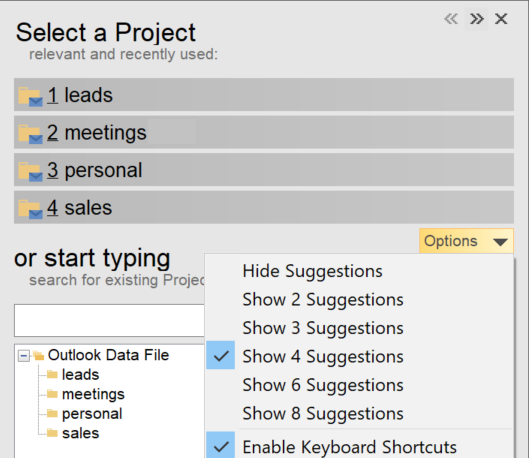
Project Selector: Keyboard shortcuts are now supported to select the suggested Projects shown in the upper buttons. To enable, click on the Options button, and the menu item Enable Keyboard Shortcuts. Once enabled the buttons will be numbered and keystrokes such as Alt-1, Alt-2, etc. will trigger the suggested buttons.
Defer: When one-click Defer is enabled, and pinned time interval buttons are set, the pinned times are now shown in the Outlook Ribbon menu under the Defer button.
Followup: Fix issue where the Task Subject under the Options section was not getting preset from the subject of the message.
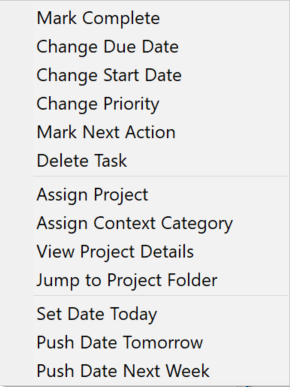
Organizer/Dashboard: Add a right click option for Tasks to Jump to the Project folder. If a Project is assigned for the item, Outlook will navigate to the Project folder.
Organizer/Dashboards: No longer show outdated Context categories from completed Tasks and Appointments when they have not been used in some time. (the original categories in the items themselves are unaffected)
Detail Dashboard: Optimize placement when opening Detail Dashboard to try and avoid having the bottom cut off below screen
Project Move/Archive: Add notifications if there is a problem moving message or deleting the original folders. Avoid deleting original folders if they are not empty.
The update is being delivered now to users on the beta and early update channels, and will roll out soon to all users in the coming weeks. The build number in the About screen will show as 2309.1. Note: beta testers may have already received a 2309.0 build, this build fixes an issue with Project Selector shortcuts when there are more than 9 suggestions showing.
A product update is rolling out with the following improvements and fixes:
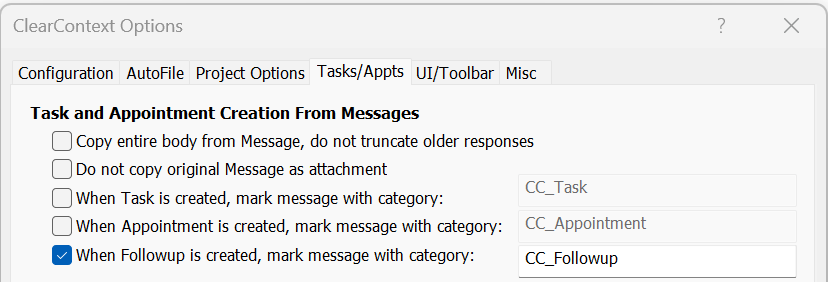
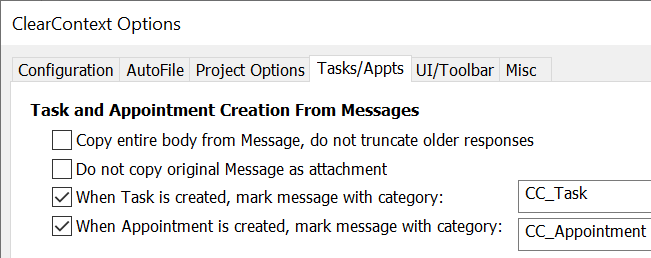
Followup: Messages that have a Followup task created can now have a category applied to them indicating that a Followup was created. This option is accessed in the ClearContext Options screen under the Tasks/Appts tab, next to the similar options that can tag a message when a Task or Appointment is created from them.
Organizer: The Project and Context view tab now have an option to filter Tasks by date. This function works similarly to the Weekly Planner and Review Completed views, where items can be filtered for 1, 2, 4 or 8 weeks.
Organizer: A new right click option is available on the Task list where the date of a Task can be set to today, tomorrow or next week. This option is useful for quickly pushing out the date for a due or overdue Task. Either the Due or Start Date of the task will be set according to whether the Organizer is configured to manage by Due or Start Date.
Dashboard: Similar to the above, both the Summary and Detail Dashboards also provide a right click option on Tasks to set the date to today, tomorrow or next week.
File Sent Messages: A new delete button has been added the File Sent Message screen to easily delete messages one does not want to file or keep. Additionally, the screen can now be resized larger, and this size will be remembered when the screen is opened again.
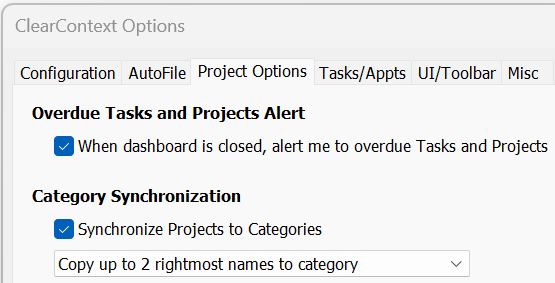
Project Category Sync: ClearContext copies the Project name to the Outlook categories for items by default. There is now an option to only copy over the rightmost portions of the Project name to make the displayed category more concise. This option is accessed in ClearContext Options screen under the Project Options tab.
Project Selector: the text search/entry box in the Project Selector for filing and assigning Projects now supports the control-backspace shortcut key to delete the previous word.
Issue: Address the problem when the Defer and Followup functions are launched from the Ribbon in the main Outlook window, the window could sometimes be placed at the bottom right of the screen.
Bug Fix: Address issue for certain European locales, where the date selector used in the Dashboards, QuickTasks and Organizer would not pick the correct date when the Next Week button was used.
The update is being delivered now to users on the beta update channel, will roll out soon to the early update channel, followed by all users in the next few weeks. The build number in the About screen will show as 2209.0.
A product update is rolling out with the following improvements and fixes:
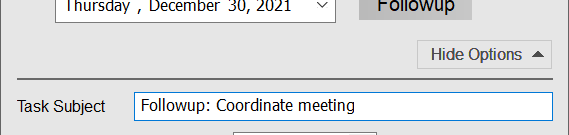
Followup: The subject of the Followup Task may now be set from the Followup window before the Task is created. To set the subject, click the Show Options button on the bottom of the screen if the additional options are not already visible, and edit the Task Subject field.
Tasks and Appointments: When creating a Task or Appointment from a message, the original message can now have a category tagged to indicate that a Task or Appointment has been created for that message. While this status is already shown in the MessageContext, this additional indicator is useful for users that do not use the MessageContext or want a more prominent indicator. This option may be enabled in the ClearContext Options screen in the Tasks/Appts tab.
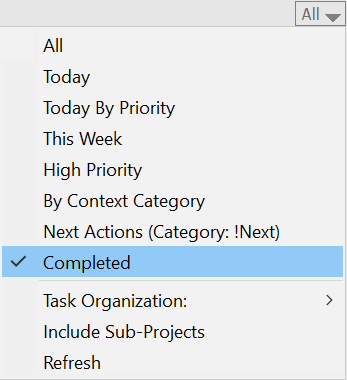
Dashboard: In the Project Detail Dashboard, there is a new view available for Tasks to show the completed tasks for the Project. To access the option click on the view button on the top right area of the Task list.
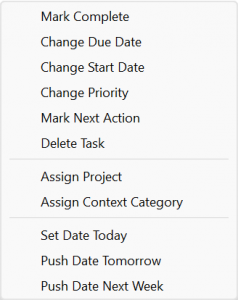
Dashboard: In both the Summary and Detail Dashboards, Tasks can now be deleted by selecting a Task and right clicking with the mouse.
Organizer: Similar to the above, Tasks can now be deleted by selecting a Task and right clicking with the mouse.
License Updates: For situations where ClearContext is blocked from automatically updating the subscription status due to firewall or security restrictions, license updates can now be sent through an email message. Users can contact support to request an email based license update.
Bug Fix: Address issue when printing reports from the Organizer in certain computer configurations, where the icons could appear as blank or dark rectangles.
The update is being delivered now to users on the beta update channel, will roll out soon to the early update channel, followed by all users in the next few weeks. The build number in the About screen will show as 2112.0.
A product update is rolling out with the following improvements and fixes:
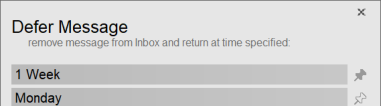
Defer and Followup: Specific time intervals can now be pinned to the 4 quick select buttons on the screen. To make a button always show a specific time, click on the pin button to the right.
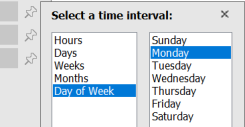
Defer and Followup: When using the new pin option mentioned above, a new type of time interval for a specific day of week is now available. For example, a button can be assigned to always Defer or Followup to the following Monday.
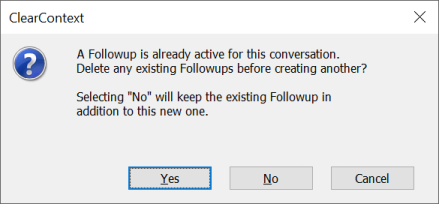
Followup: When creating a new Followup and there is already an active one on the same message conversation, there is now an option to delete any existing Followup tasks upon creation of the new one.
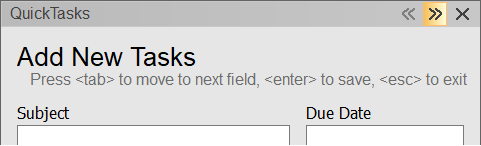
QuickTasks: Different window sizes are now available by clicking on the increase or decrease buttons on the top bar, similar to the size options on the Project/Filing window.
QuickTasks: The Project selection drop down now resizes wider up to the available space when long Project names are displayed for easier readability of long Project names.
QuickTasks: The Date label now shows whether the date selector is setting the Start or the Due Date, according to the Start/Due preferences set in the Dashboard.
Bug Fix: Avoid the issue where on rare occasions, the splitter bar in the Dashboard window could be set outside the visible area so that it was difficult to bring lower portion of the window back to being visible. Also, improve the appearance and size of the splitter bar on high resolution displays.
Bug Fix: Improve the dismissal of the welcome screen when Outlook is started, in certain cases where the window was not automatically closing itself.
The update is being delivered now to users on the beta update channel, will roll out soon to the early update channel, followed by all users in the next few weeks. The build number in the About screen will show as 2104.0.
A product update is rolling out with the following improvements and fixes:
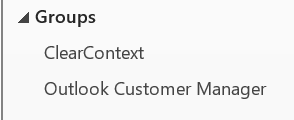
Office 365 Groups: Filing to shared mailboxes in Office 365 Groups is now supported. This functionality can be enabled in the ClearContext->Options screen where the Groups can be enabled in the mail file list.
UPDATE – since the release of this feature, Outlook is no longer allowing the import of existing emails into the Groups folders. Use of ClearContext group filing will result in either the message not being moved, or the message being moved only to the local Group folder in Outlook and not synced to the online Group folder.
* Please note that Group folders have restrictions compared to normal mail folders, so ClearContext can only support them as a filing destination and not for Project/Dashboard functions. In addition, Outlook cannot create new folders within the Groups, only existing folders can be used.
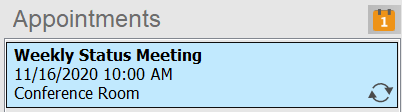
Project Dashboard: Recurring appointments are indicated with an icon. Text colors adjusted to be more readable with certain background category colors.
Dark Mode: Changed text colors in various screens for improved readability and contrast.
Bug Fix: when replying to a message, if a Task or Appointment was created from the composed message, then aborted, other actions after sending message such as filing the sent and/or original message were skipped. Other actions will no longer be affected if a created Task or Appointment is not saved.
Bug Fix: When moving/renaming a Project, if a Project was moved/renamed to one of its children/sub-folders, the parent folder would get deleted. Example: moving “sales” to “sales/new” would cause the entire “sales” hierarchy to be moved to the deleted folder. Parent folders will no longer be deleted in this case.
Bug Fix: When the Project Dashboard is open, and when Task items are updated in certain ways, the Summary Dashboard would lose focus on the current Project and cause next/previous navigation to reset to the first Project in the list. The current focus is now preserved to avoid this problem.
The update is being delivered now to users on the beta update channel, will roll out soon to the early update channel, followed by all users in the next few weeks. The build number in the About screen will show as 2011.0.
A product update is rolling out with the following improvements and fixes:
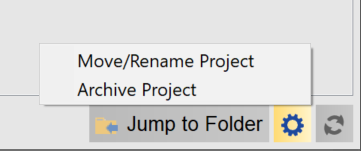
Project Archive: A new function has been added to manage completed Projects. This will relocate items such as the Project folder, messages*, notes, tasks and appointments belonging to a Project to an archive location outside the active workspace. Additionally, the archived Project will be unassigned from any message conversations and no longer used for Project suggestions. This function is accessed from the Dashboard Project Detail screen.
Move Project: The Project folder being moved/renamed will now be deleted when possible.
Organizer: Column sorting is now remembered for the list according to the last use. The setting is remembered individually for each view tab (Dates, Project, Context, Recent, Weekly Planner, Review Completed).
Dashboard Project Detail: Like the Organizer the task list column sort is now remembered.
Dashboard: improve colored text contrast in dark mode.
Performance Improvement: Resolve a conflict with the Outlook Dictate function where excessive slowdowns would occur.
Bug Fix: Address positioning problem for action windows launched from the Ribbon toolbar, such as the Project selection window, when the computer is configured with multiple screens with different display scaling settings.
* Note: folders and messages are not relocated for Procesed Mail/single folder filing
The update is being delivered now to users on the beta update channel, will roll out soon to the early update channel, followed by all users in the next few weeks. The build number in the About screen will show as 2007.0.
A product update is rolling out with the following improvements and fixes:
Dark Color Themes: For Outlook 365 and Outlook 2016/2019, support for the Dark Gray and Black themes have been improved to better match the Outlook display, particularly for the Dashboard and MessageContext.
Organizer Printed Reports: Blank lines for handwritten notes have been added to printed reports when space is available.
Dashboard: For the Today by Priority view, keep appointments sorted ascending by date instead of descending like the tasks.
Project/Folder Selection Window: Checkbox option relocated to the right side to prevent accidental selection. This affects display when Project window is shown when messages are sent and when filtering Projects from the Organizer.
Bug Fix: When moving/renaming Projects, only relabel categories if the Project to Category sync option is enabled in Options.
The update is being delivered now to users on the beta/early update channel, and will be going out to all users within the next few weeks. The build number in the About screen will show as 2002.0.
This release includes the following improvements and fixes:
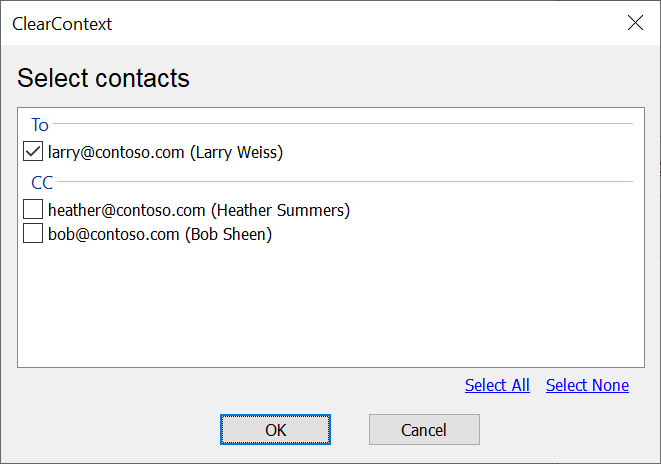
Followup: New contact selection screen for when Followups are configured to cancel only on specific senders. Instead of having to manually edit the list of email addresses, the new selection screen shows contacts by type (from, to, cc) and allows easy selection.This function can be accessed from the Choose button next to the list of email addresses to cancel for.
Followup: When cancelling for specific senders, only direct recipients are selected by default. CC’ed recipients can be added from the selection screen described above.
Bug Fix: Searching in the Detail Dashboard could result in crashes if ClearContext was configured in the single folder filing mode
Bug Fix: In 64 bit versions of Outlook, messages files cannot be previewed in the Attachment Explorer. Prevent notifications windows from appearing in this case.
The update is being delivered to all users and should arrive shortly. The build number in the About screen will show as 1908.0.
This release includes the following improvements and fixes:
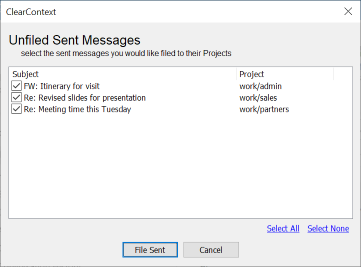
Unfiled Sent Messages: New feature to file messages in the Sent Items folder that belong to a Project but are unfiled. When automatic filing of sent messages is enabled, some emails may remain unfiled because emails were sent from a device without ClearContext, or if a Project wasn’t assigned right at the start of a conversation.
This function can be accessed from the new File Sent Messages button in the ClearContext toolbar. Also, a notification will appear in the Daily Digest if automatic sent message filing is enabled and messages to file from the Sent Items folder are found.
AutoFile: In rule list screen, show if Delay Filing option applies to rule
AutoFile: In rule list screen, add button to create new rule
AutoFile: In rule create/edit screen, add option to choose if rule is to be applied to current Inbox items, instead of always applying rule
Bug Fix: When a Project is pre-selected in QuickTasks, the mail file the Project belongs to could sometimes be incorrectly set to the primary mail file instead of the mail file the Project belongs to
Bug Fix: When a task project is updated through the Task Inspector window, the category sync of the Project name can be incorrect if other user categories are present
Bug Fix: Add scroll bar to Activity History window
The update is being delivered first to users on the beta/early update channel, and will follow with all users in the next few weeks. The build number in the About screen will show as 1905.00.
This release includes the following improvements and fixes:
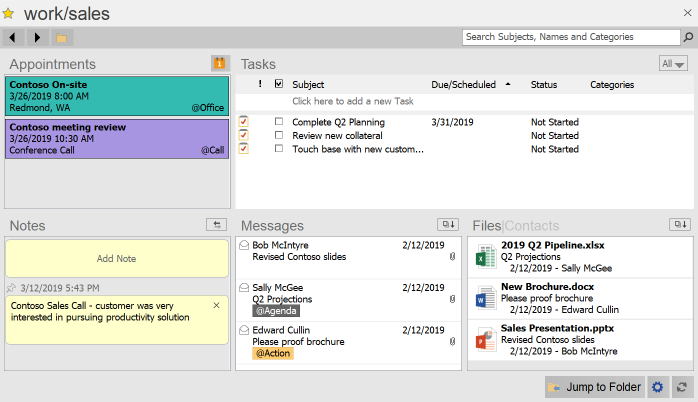
Project Detail Dashboard: new Messages window that shows associated Project emails that have been filed or are pending in the Inbox. *available only in standard Project folder filing mode
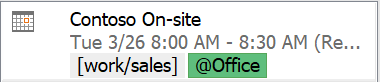
Category Colors: displayed category labels now show the Outlook color category coding in the Dashboard and Organizer.
Automatic Updates: rework download mechanism to increase compatibility with firewalls/security settings
Misc: various updated graphics
Bug Fix: prevent creation of duplicate filing suggestions in certain situations
The update is being delivered now to users on the beta/early update channel, and is scheduled to go out to all users in the next few weeks. The build number in the About screen will show as 1901.00.