Is your inbox stuffed with Facebook updates, Linked in requests, shopping offers, newsletters and all manner of flotsam? Do those emails coming in obscure the emails you need to deal with, or even worse distract and pull you away from things you need to get done? Some sources estimate that more than 80% of emails received are these types of automated, low priority messages.
ClearContext Autofile can help thin out this morass of non-urgent email. AutoFile quickly and automatically declutters your inbox so that you can focus on what’s important and get things done. Out of the box, Autofile has built in filing rules for the many common sources of automated email including Facebook, Twitter, Tumblr, LinkedIn and Evite and many more. Additionally, additional sources of unimportant email you receive can be added instantly with one click – diverting all future email out of your Inbox.
ClearContext reports on these AutoFiled emails once a day in a digest, so they don’t get lost or forgotten. Instead, you can review the list of these emails efficiently at the time best for you. It’s hard enough keeping up with the constant stream of emails arriving in your Inbox without all the distractions – ClearContext can help condense down your incoming messages to those that are most important.
Posted by ClearContext at 2:28 pm on September 26th, 2016.
Categories: clearcontext, daily_workflow, productivity.
ClearContext makes filing emails to a Processed Mail folder while tagging them with a Project easy, often with just one click! Michael Linenberger’s MYN system recommends filing all emails to a single Processed Mail folder so that you can easily view all of your filed email by different criteria. By using the grouping and sorting built into Outlook, one can easily change the view of the folder by category, sender, or other criteria. And since ClearContext automatically tags Projects into the category field, emails are viewable grouped into Projects as well.
The MYN version of ClearContext Professional is configured for one click filing to the Processed Mail folder by default. Users of the standard version of ClearContext Professional can also take advantage of this capability by going to the ClearContext Options screen, setting the root filing folder to “Processed Mail”, and checking the option to file all messages to this single folder.
ClearContext’s smart filing features are one of many capabilities that help you clear your Inbox faster and easier, regardless of whether you prefer the MYN Processed Mail filing system, or traditional filing to separate Project folders.
Posted by ClearContext at 3:17 pm on July 12th, 2016.
Categories: productivity. Tags: Master Your Now, Michael Linenberger, MYN, Total Workday Control.
ClearContext has special task, schedule and follow up features that make processing emails into actionable work quick and easy. Tasks can be created from emails by pressing the Task button. A task window pre-populated with information from the email will pop up and the start date can be set for FRESH prioritization. If you have a due date you can optionally add that to the task name. Another convenience is the option to automatically file the original email into the Processed Mail file and assignment of a category/project at the same time.
Appointments can be scheduled in a process similar to the Task button with the Schedule button under more actions on the ClearContext toolbar. In the same way, the appointment parameters can be set, the original message filed to the processed mail folder and assignment made to a category/project all from the same step.
Follow up tasks are used to make sure a response has been received to a sent email. While composing an email, the Followup button can be selected on the ClearContext toolbar/menu to automatically create a follow up task when the email is sent. This follow up task will have the original email attached and named “Followup:” plus the original email subject. Conveniently, this follow up task will automatically be completed if the recipient replies to the email, saving time and effort for checking up on important emails.
The Task, Schedule and Followup features are just a few examples of how ClearContext can help you become more productive with getting your work done in Outlook and with Michael Linenberger’s MYN.
Posted by ClearContext at 3:28 pm on June 30th, 2016.
Categories: productivity. Tags: Master Your Now, Michael Linenberger, MYN, Total Workday Control.
The Master Your Now (MYN) version of ClearContext saves you time in implementing Michael Linenberger’s MYN methodology in Outlook because it come configured out of the box with the 11 views outlined in Michael’s book Total Work Day Control using Microsoft Outlook. It contains the essential To Do Bar view as well as the email filing view and the advance views. This automatic set up of these views will save your tedious and time consuming work and will speed you on your way to getting your inbox and your life under control. Full information on the MYN version of ClearContext can be found here: clearcontext.com/myn
We also offer the MYN views in a simple standalone product. This product can be used by itself to install and maintain the MYN views, or together with the standard version of ClearContext Professional. For more information on the MYN views utility, please visit mynviews.com
Posted by ClearContext at 3:03 pm on June 24th, 2016.
Categories: productivity. Tags: Master Your Now, Michael Linenberger, MYN, Total Workday Control.
We have updated our Activewords wordbase to support ClearContext Pro v5.2. In addition to previously released shortcuts to file, defer, unsubscribe and create tasks/appointments we have added quick access to create an AutoFile rule and mark a message important. See our Activewords partner page for more detail and a link to the download.
 For those of you new to ActiveWords, this powerful productivity tool adds keywords to Windows, providing a personal, portable, context free user interface with immediate response. Your words launch programs, jump to websites, send email, substitute text, search, and more. Receive information about any word or phrase in any context. Enter or select words in any context and your computer immediately delivers the results you want. Go to the ActiveWords website for additional information and a free download of the application.
Posted by brad at 8:22 am on December 16th, 2010.
Categories: productivity.
We are pleased to announce the release of an ActiveWords wordbase for ClearContext! The new wordbase – free for ClearContext and ActiveWords users – provides quick access to eight core ClearContext inbox management features using keyword shortcuts; including file, defer, unsubscribe, task, schedule, etc.. Download the word base here.
For those of you new to ActiveWords, this powerful productivity tool adds keywords to Windows, providing a personal, portable, context free user interface with immediate response. Your words launch programs, jump to websites, send email, substitute text, search, and more. Receive information about any word or phrase in any context. Enter or select words in any context and your computer immediately delivers the results you want. Go to the ActiveWords website for additional information and a free download of the application.
Posted by brad at 9:55 am on August 3rd, 2010.
Categories: productivity.
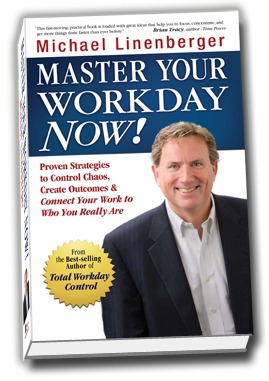
 As long time readers are aware, we are big fans of partner Michael Linenberger’s no-nonsense approach to email and task management. This week he has released a new productivity book, Master Your Workday Now! Michael’s new book outlines an approach for overcoming overwhelm and achieving your highest level goals. From www.masteryourworkday.com:
“Within minutes of picking up this book you will:
- Get more done, more quickly (and then get home earlier)…
- Eliminate overwhelm (because it’s impossible to accomplish the critical, big-picture tasks when you’re buried under an avalanche of ‘minutiae’)…
- Develop hyper-focus, and concentrate on the task-at-hand (so you’re less prone to distraction from outside influences)…
- Create, and master, a more productive life…
- Have your day support your goals.
- Restore much-needed sanity to your work life…
- Instill order and sense to your daily tasks and e-mail …
For a limited time, Michael is including a free bonus video and other gifts when you order Master Your Workday Now! See MasterYourWorkday.com for more detail.
Posted by brad at 8:56 am on March 9th, 2010.
Categories: productivity, twc.
It's been a long wait, but the Office team is finally giving the public a preview of Outlook 2010, slated for release in the first half of next year. Check out the end of this post to read more about Outlook 2010.
But why wait for 2010 when ClearContext Personal and Pro have Outlook 2003 and 2007 users covered already? Here’s a breakdown of some of the new Outlook 2010 features and their ClearContext counterparts.
Ignore Thread \ Unsubscribe
 Outlook 2010’s new Ignore Thread feature moves all messages in the current conversation to the Deleted Items folder. Future messages are also automatically removed from the Inbox. ClearContext’s Unsubscribe performs the same function, plus lets you review the messages later or resubscribe to a conversation.
Conversation View \ MessageContext
 The new default view for Outlook 2010 is a conversation view that groups all related messages together in the Inbox. ClearContext provides a similar threaded conversation view for the Inbox. More importantly, the MessageContext window displays the entire conversation for each open message. In Pro, it also shows any tasks or appointments generated during the course of the current conversation.
Quick Steps
 Quick Steps in Outlook 2010 are a way to set up macros for commonly used multi-step functions. ClearContext filing features provide many common functions without the need to create any macros — including single click filing (message or thread), automatic message filing when replying (or creating tasks and appointments), and automatic filing based on email history.
Product Roadmap
It's nice to see productivity features like these making their way into Outlook – but at ClearContext we're already working on the next generation of more intuitive, powerful and automated productivity features for email. Tomorrow we’ll post our full product roadmap, highlighting our continued mission to help email overloaded individuals more effectively prioritize, organize and manage their email and projects within Outlook.
More Info on Outlook 2010
Here’s the official Outlook 2010 preview video:
Here’s Robert Scoble’s longer interview with Chris Bryant, Group Product Manager for the Office 2010 team.
Posted by brad at 9:46 am on July 14th, 2009.
Categories: clearcontext, outlook, product, productivity.
The Information Overload Research Group is putting on a 90-minute online event on Monday with a great group of speakers.
Dr. Oliver Brdiczka from PARC, Prof. Gloria Mark from UC Irvine, Col. Peter Marksteiner from the USAF, and Jonathan Spira from BASEX will be sharing a wide variety of perspectives on INFORMATION OVERLOAD: THE IMPACT ON THE ORGANIZATION.
The event is free, but does require registration, so please take a look at the agenda, sign up, and join us Monday for what will be a very interesting session.
Posted by deva at 11:29 am on April 24th, 2009.
Categories: productivity.
Lifehacker has posted a list of email innovations they would like to see become commonplace in email applications. Between the items listed and wishes in the comments of the post, it looks like ClearContext has pretty much got Outlook users covered. Let’s take a closer look.
From the post:
 Snooze This Message
Sometimes you just don’t need to deal with an email message this very second, but you don’t want it cluttering up your inbox or lost in a folder somewhere. Adding a "Snooze button" to your inbox could solve the problem: You hit "Snooze" on a message and it disappears from view—until a day later, when it reappears again, unread and in your inbox, ready for processing.
ClearContext’s Defer feature pulls a message out of the Inbox until you have time to deal with it.
Faceted Search/Related Messages
Your email inbox and sent mail archive is basically a huge personal database of communication over time, and smart search can help you slice and dice it by topic and sender.
ClearContext Pro and Personal have been showing message threads grouped together in the Inbox since v1 of the product. In addition, the ClearContext RelatedView displays all messages, tasks and appointments in the current conversation as an integrated window within each item, giving a clear context for the current message you are working with.
From the post’s comments:
 Notify me if no reply in X days.
Am I the only one who sees a need for this? How many times have you sent an e-mail that requires a reply and the jerk…I mean colleague…at the other end ignores it? Better yet if you could send an automated nag after a given period of time.
Use ClearContext Pro’s follow-up feature to notify you if you don’t receive a timely reply from an important email.

MUTE THREAD.
I get so much traffic at work from threads that I don’t need to see. When it first becomes irrelevant, I would like to be able to click a button and mute the thread, whereby all further messages in that thread go straight to a folder without cluttering my inbox.
Yep, got that too. Unsubscribe – available in both Pro and Personal.
 ClearContext also adds message prioritization, automatic filing, and advanced attachment viewing and management. What else would you like to see? Reply to All protection? Attachment alerts? Send your ideas to info at clearcontext dot com.
Posted by brad at 1:55 pm on August 18th, 2008.
Categories: productivity, tips.